Does Acupuncture Hurt? An Honest Answer From a Doctor
Twenty-five years of holding the needles, and a straight answer about what they actually feel like.

September 1, 2026 · 7 min read
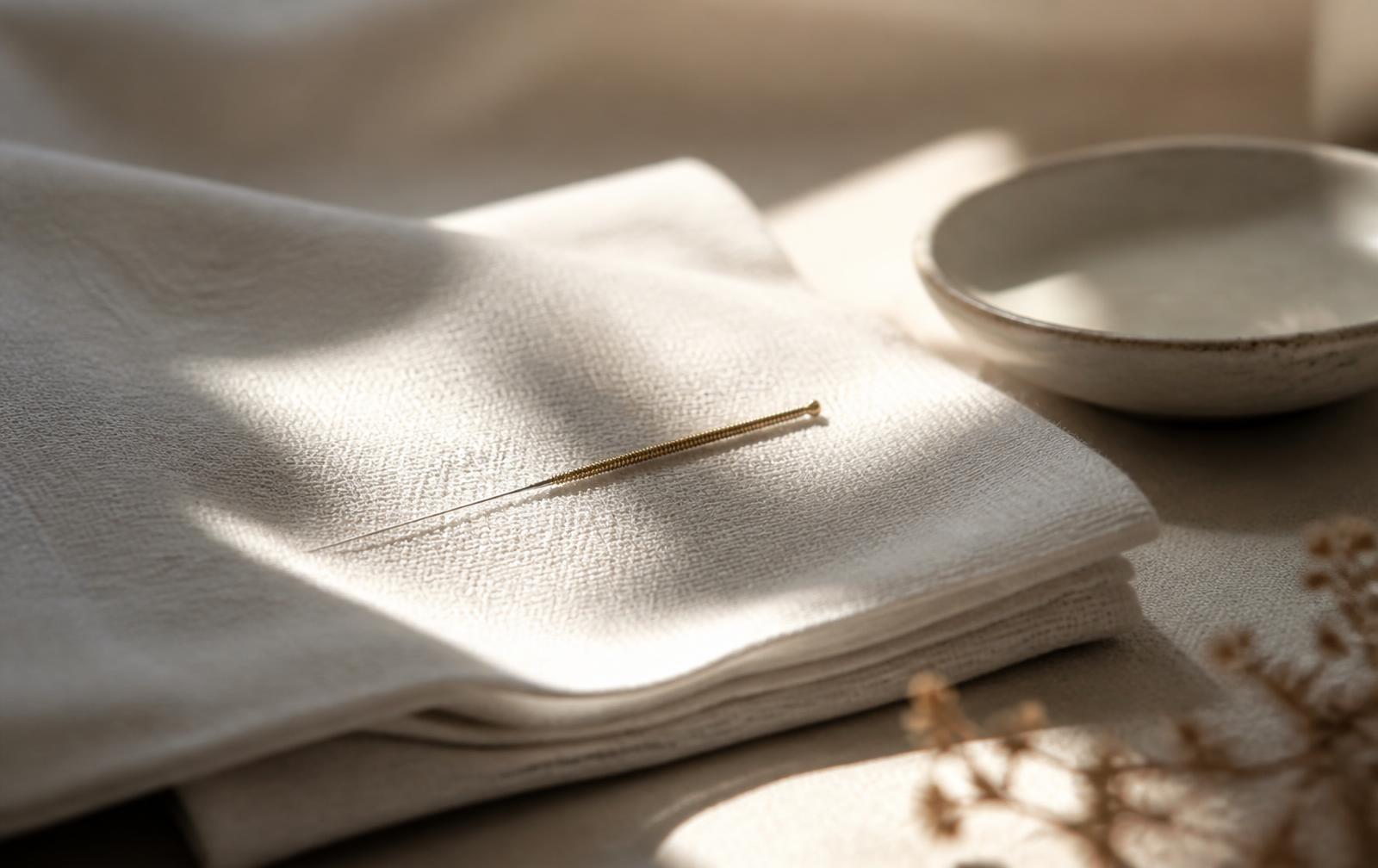
Short answer: for most people, no. An acupuncture needle is about the width of a human hair. Most insertions are not felt at all. A few produce a quick pinch that fades in a second, and then a dull, heavy, spreading feeling that is a treatment response rather than pain.
The longer answer matters more, because the people asking this question are rarely idly curious. They are usually deciding whether to try something for pain, anxiety or sleep that they have been putting off, and the needles are the reason they have not.
What the needle actually is
Almost all of the fear here comes from picturing the wrong object. The needle in a blood draw or a vaccination is hollow, comparatively thick, and designed to move fluid through its center. An acupuncture needle is solid and filiform, typically between 0.16 and 0.30 millimetres across. Thirty to forty of them fit inside the bore of a single hypodermic needle.
That difference is not a reassurance script. It is the reason the sensation is different in kind, not just in degree.
What it feels like, point by point
At insertion, most points give nothing at all. Some give a brief, bright pinch at the level of the skin that is gone before you finish noticing it. Once the needle is in place, many people feel a dull ache, a heaviness, a warmth, or a sensation that travels away from the point. In Chinese medicine that is de qi, and it is usually taken as a sign the point has been engaged correctly.
Sensitivity is not uniform. The hands and feet have thin skin and dense innervation, so they are felt most. The back, abdomen and the fleshier parts of the legs are felt least. Ear points are a sharp prick that settles quickly.
Afterwards, mild soreness at a few points, occasional small bruises, and a heavy or sleepy feeling for a few hours are all common. Sharp or radiating pain is not normal, and it should be said out loud during the session rather than endured.
Why the first session usually feels like the most
The pattern I saw for twenty-five years in clinic was consistent. The people who felt the most were the people who arrived most braced. A guarded body tightens the exact tissue the needle is passing through, and a nervous system already running hot reads every input as louder than it is.
Most of what people call the pain of acupuncture is the anticipation of it.
That is not a dismissal of the fear. It is the most interesting thing about it. The same mechanism that makes a hair-fine needle feel like a threat is the mechanism that keeps chronic pain, insomnia and anxiety switched on long after the original cause is gone. The body is running a rule about danger.
If needles are the reason you never went
I hold the doctorate and keep the license current, and I taught clinical diagnostics for a decade. What changed is where I get results. I wrote about that shift in acupuncture and the nervous system. Regulation on the table was real, and the results got faster and held longer once the work moved to the rule underneath the pattern.
For someone whose honest obstacle is the needles, that turns out to be good news. Nothing in the work I do now involves them. Rapid Inner Transformation is three private sessions of clinical hypnotherapy, RTT, NLP and somatic regulation, from the practice in Hendersonville, Tennessee and virtually. Clinical hypnosis has one of the stronger evidence bases in mind-body medicine for altering pain perception, and it works on the driver rather than the state.
If you want the mechanics of that, the clinical guide to reprogramming the subconscious mind walks through it step by step.
If acupuncture is still what you want
It can be a good fit, and there is a way to make a first session comfortable. Say at the start that you are needle-averse, and ask for fewer points and shallower insertion. A skilled practitioner adjusts without being asked twice. There is no reason to white-knuckle a treatment that is supposed to calm you down. If you want a read on whether needles or the needle-free route fits your case, bring it to a free consultation and we will talk it through.
Common questions
- Does acupuncture hurt?
- For most people, no. A filiform acupuncture needle is roughly the width of a human hair, and nothing like the hollow needle used to draw blood. Most insertions are not felt at all. Some produce a brief pinch at the skin that fades within a second or two, followed by a dull, heavy, spreading sensation practitioners call de qi, which is a normal treatment response rather than pain.
- Does acupuncture hurt the first time?
- The first session is usually the most uncomfortable, and almost always because of anticipation rather than sensation. A guarded body tenses the tissue the needle is entering. People who arrive already braced tend to feel more, which is one of the clearest signs that the nervous system, not the needle, sets the experience.
- Which acupuncture points hurt the most?
- The hands and feet are the most sensitive areas, because the skin there is thin and densely innervated. Points in the fleshier parts of the back, abdomen and legs are usually felt least. Ear acupuncture is a brief sharp prick at insertion and then settles.
- Is it normal to be sore after acupuncture?
- Mild soreness at a few points, a little bruising, or a heavy, sleepy feeling for a few hours afterwards are all common and short-lived. Sharp, radiating or worsening pain is not normal, and it is worth telling the practitioner during the session rather than after it.
- What if I am afraid of needles?
- Needle fear is a real and common reason people never try acupuncture, and it does not need to be argued with. There are effective routes to pain relief and anxiety relief that involve no needles at all, including clinical hypnotherapy and nervous-system regulation, which is the work Dr. Perry does today.
- Does Dr. Tara Perry offer acupuncture?
- No. She is a Doctor of Acupuncture and Chinese Medicine with twenty-five years of clinical practice, and acupuncture is not a service she currently offers. Her Chinese medicine background informs how she reads a nervous system. The work itself is Rapid Inner Transformation, a three-session hypnotherapy and subconscious reprogramming protocol.
- What works for pain without needles?
- Clinical hypnosis has one of the better evidence bases in mind-body medicine for pain perception, and it pairs with somatic regulation and subconscious work to address what keeps a pain or stress pattern switched on. The free consultation exists to work out which layer your problem actually lives on, and you will get a referral rather than a pitch if the answer is something else.