Does Acupuncture Work for Anxiety? A Doctor's Honest Answer
An honest answer from someone who spent twenty-five years holding the needles, and who no longer offers acupuncture as a service.

August 14, 2026 · 7 min read
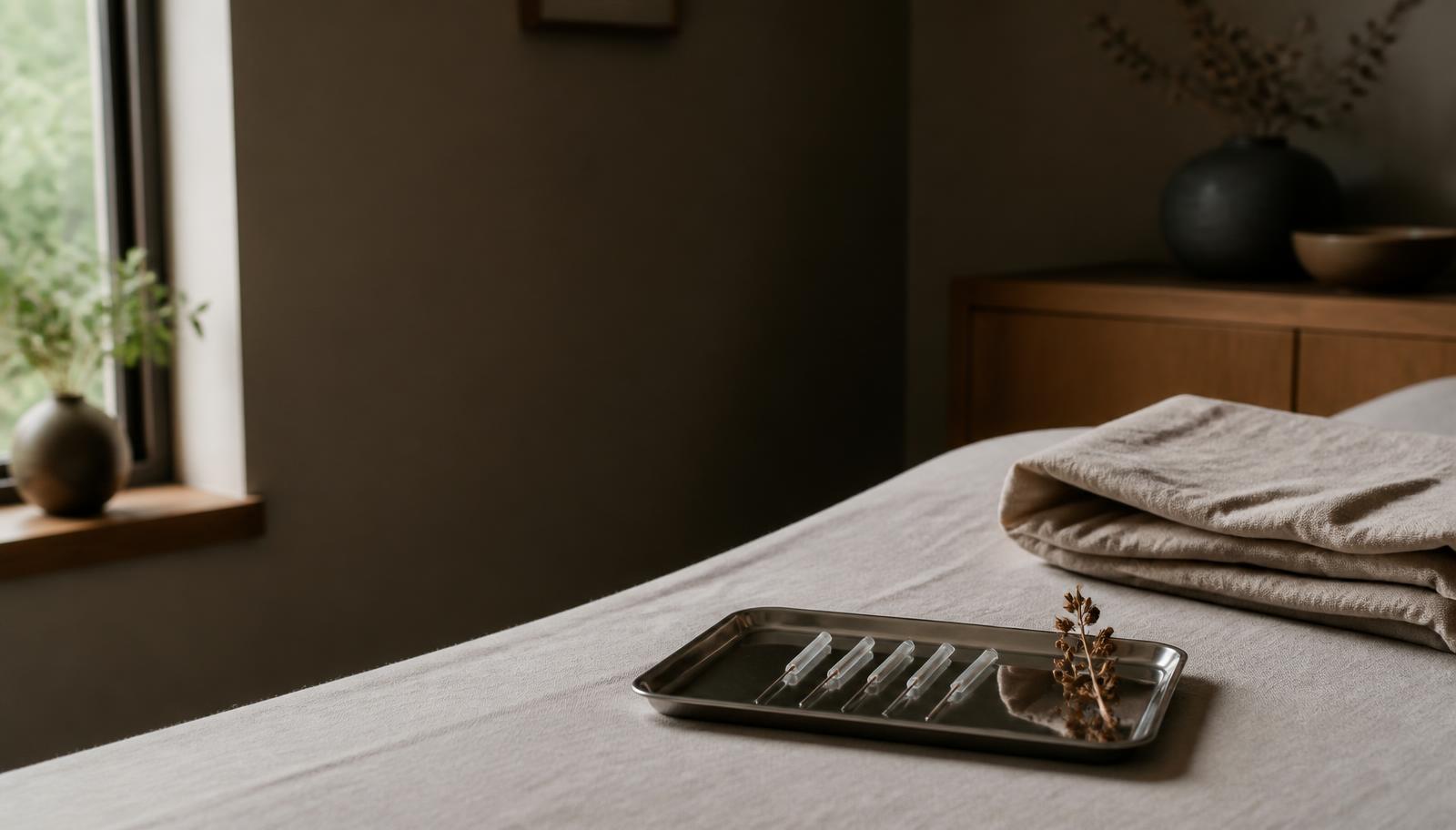
Short version: yes, usually, and not permanently. Acupuncture is very good at changing the state your nervous system is in right now. It is far less reliable at changing the rule that keeps putting it back there.
That distinction took me most of a career to see clearly. I am a Doctor of Acupuncture and Chinese Medicine. I taught clinical diagnostics and meridian theory at Emperor's College for ten years and held the inaugural acupuncture appointment at UCLA's Arthur Ashe Center. I do not offer acupuncture today, and the reason is in this article rather than in a disclaimer.
What acupuncture actually does to an anxious nervous system
Anxiety is not only a thought pattern. It is a body running with the sympathetic branch dominant: shallow upper-chest breathing, elevated resting heart rate, low heart rate variability, jaw and shoulder guarding, poor sleep onset. Anything that shifts that balance will feel like relief, because it is.
Needling reliably produces that shift. In the treatment room you watch it happen inside ten minutes: breathing drops into the belly, the face softens, people fall asleep on the table. The research broadly agrees with the clinical picture. Systematic reviews of acupuncture for anxiety generally find meaningful improvement against waitlist and usual care, with smaller and noisier differences against sham needling, which is exactly what you would expect from an intervention whose main mechanism is autonomic downshift plus a strong therapeutic ritual.
None of that is a criticism. A downshifted nervous system is genuinely valuable, and for someone in acute overwhelm it can be the most useful hour of their week.
Why the anxiety kept coming back
Here is the pattern that eventually redirected my practice. A client would come in weekly, regulate beautifully, sleep better, feel like themselves again. Then a specific trigger would land, a performance review, a phone call from a parent, a room they had to walk into, and the whole response would fire exactly as before.
You can calm the body every Tuesday, and the rule will still be there on Wednesday.
The treatment was working. It was working on the state, not the driver. Underneath a recurring anxiety response there is almost always a learned rule, written young and under pressure: being seen is dangerous, rest is unsafe, needing help is failure. The body executes that rule faithfully.
That is the honest limit of any regulation-only approach, acupuncture included, and also breathwork, massage, and most nervous-system protocols being sold today.
What I do with that training now
My practice today is Rapid Inner Transformation: clinical hypnotherapy, RTT, NLP, and somatic regulation across three private sessions, from the practice in Hendersonville, Tennessee and virtually. The Chinese medicine training did not get abandoned; it became the diagnostic layer. I still read a nervous system before I do anything with it, still pace the work by what the body can hold, still watch for the pattern that refuses to move. It simply does not show up as needles.
The sequence matters. Regulation first, because an aroused brain defends the old rule. Then the imprint is located rather than argued with. Then it is overwritten in the language the subconscious uses, and repeated until it consolidates. That is the piece acupuncture alone was never designed to do. If you want the mechanics, the clinical guide to reprogramming the subconscious mind walks through it step by step.
If you came here looking for an acupuncturist
I am not the right person to needle you, and I will say so plainly rather than book you into something else. What I can do is help you work out which layer your problem actually lives on. If it is a body running hot with no deeper driver, a good acupuncturist may be exactly right and I will tell you that. If the same reaction has survived years of good treatment, that is a subconscious rule, and there is a faster route.
The consultation is free and exists for that question alone.
Common questions
- Does acupuncture work for anxiety?
- For many people it reduces anxiety in the short term. Controlled trials and systematic reviews generally report meaningful drops in anxiety scores compared with waitlist or usual care, with smaller and less consistent differences against sham needling. Clinically, the honest summary is that acupuncture is good at downshifting an aroused nervous system, and less reliable at removing whatever keeps re-triggering it.
- How does acupuncture calm the nervous system?
- Needling appears to shift autonomic balance toward parasympathetic activity: heart rate slows, heart rate variability improves, muscle guarding releases, and breathing deepens. That is a real physiological state change, and it is the same state clinical hypnotherapy needs in order to work.
- Does Dr. Tara Perry offer acupuncture?
- No. She is a Doctor of Acupuncture and Chinese Medicine with twenty-five years of clinical practice and a decade on faculty at Emperor's College, and acupuncture is not a service she currently offers. Her Chinese medicine background informs the diagnostic work rather than the treatment. Her practice today is Rapid Inner Transformation, a three-session clinical hypnotherapy and subconscious reprogramming protocol.
- Why did she stop practicing acupuncture?
- Because of what kept happening in clinic. Clients would regulate beautifully in the treatment room and fire the same reaction three weeks later. The nervous system had been treated. The subconscious rule driving it had not. Hypnotherapy, RTT, and NLP closed that gap, so that is where the work went.
- How many acupuncture sessions does anxiety usually take?
- In conventional practice, most protocols run one to two sessions a week for six to twelve weeks, with maintenance afterwards. That ongoing cadence is one reason people start looking for something that resolves rather than manages.
- What should I do if acupuncture helped but the anxiety came back?
- That pattern is the clearest signal that the regulation worked and the driver was never addressed. Book a free consultation. It exists to identify what layer is actually holding the pattern, and if subconscious work is not the right fit, you will get a referral instead of a pitch.