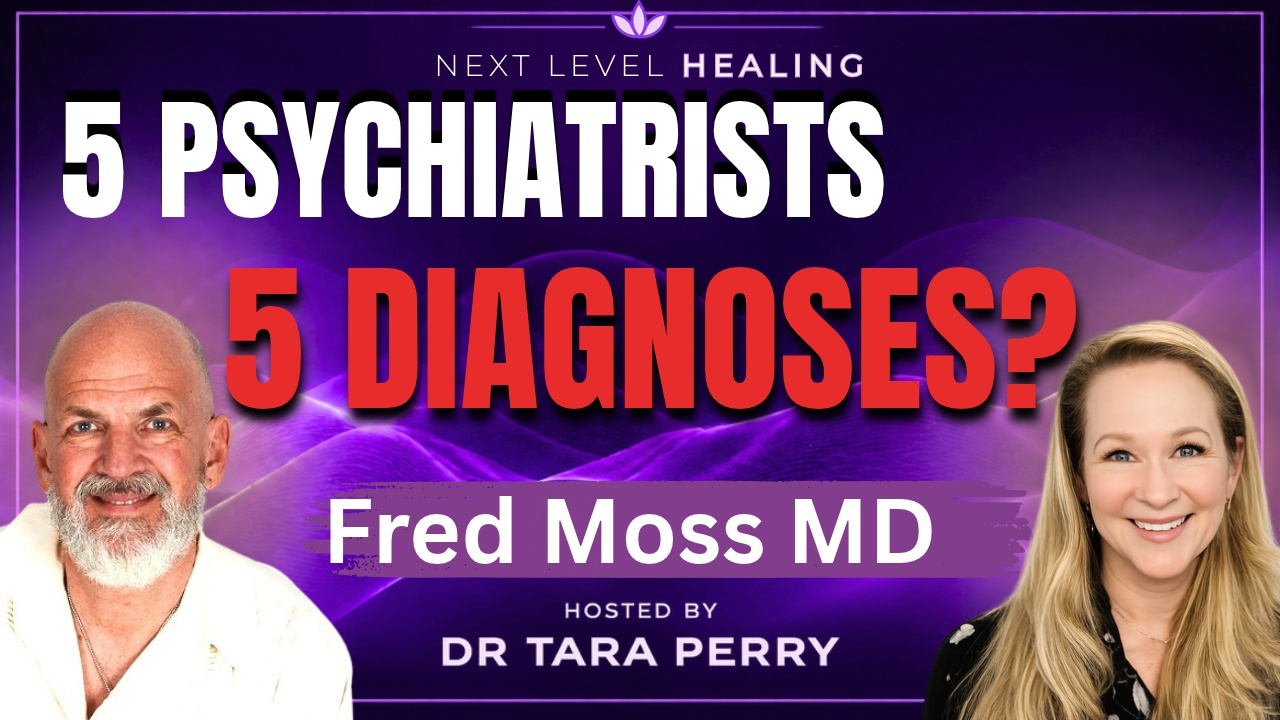
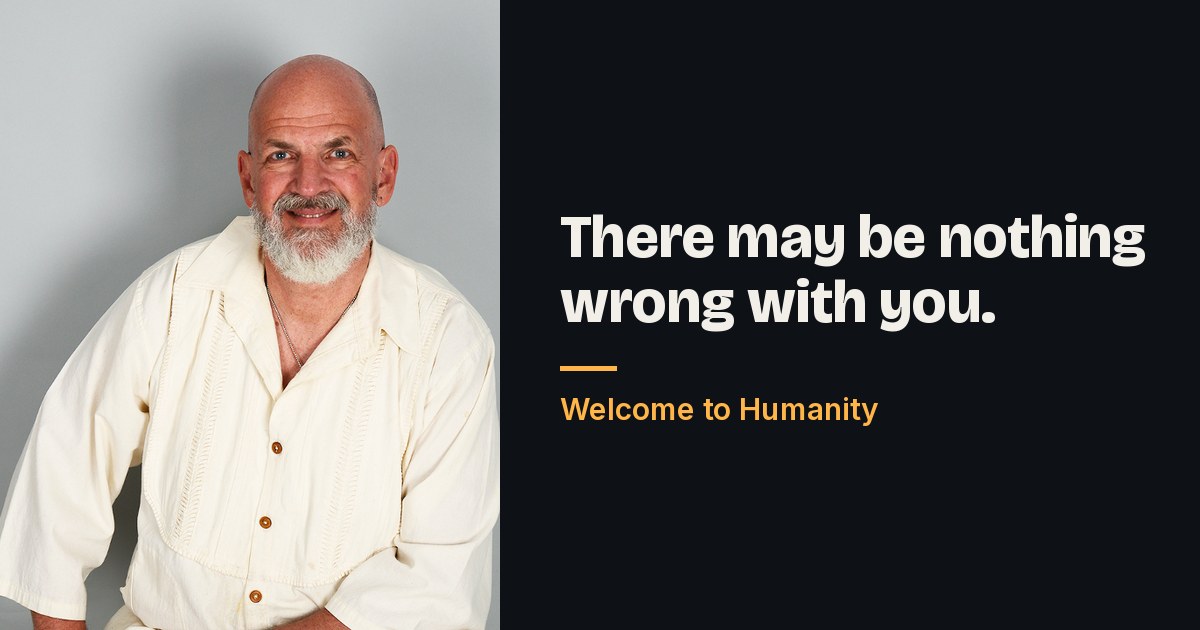
Psychiatrist Dr. Fred Moss tells Dr. Tara Perry why he believes human connection, not diagnosis, is at the heart of healing, and why there might be nothing wrong with you. His views and experience, not medical advice.
Fred and Tara talk about what he calls diagnostic adoption, his elephant parable, why feeling sad, nervous or awkward is not automatically pathology, and his memoir Welcome to Humanity.
Read the full transcript▾
_Automatic transcript. It may contain errors, and speakers are not labeled. Dr. Moss shares his own views and personal experience, which are not medical advice._
[00:00] I've got 30,000 patients under my wing. The whole point of living is to create contact with other people in connection. So when we create that, when we really get it, the heart of that healing is where the action comes from. What if you've mistaken your diagnosis with your identity? After treating more than 30,000 patients, psychiatrist Fred Moss challenges how we think about mental health and the boxes we put ourselves in. Who are you without those limits? This week on Next Level Healing, I can't wait to share this with you. Next Level Healing is for education and information only and is not a substitute for medical or mental health advice, diagnosis, or treatment.
[00:48] Welcome to this episode of Next Level Healing. I'm your host, Dr. Tara Perry. My guest today is a board certified psychiatrist with over 40 years of clinical experience who has become one of the most provocative and human voices in modern human health. Oh my goodness. He's already disagreeing with me. I'm not, that's hilarious. Where was I when that happened? You are so funny, I love it. Well, let me just finish introducing you. After decades of practicing within hospitals, correctional institutions, nursing facilities, private practice, and telepsychiatry settings, and serving tens of thousands of patients, he has reached a life altering conclusion.
[01:33] What heals people is not diagnosis, it's human connection. Welcome to Next Level Healing, Dr. Fred Moss. Yeah, it's great to be here. Thanks for having me. And yeah, I guess I reached it. Here's the thing. It's often, it's not stated exactly accurately. And I'm not meaning to upshoot what you said, but I didn't reach that conclusion after all these years. That conclusion has been here the whole time. It got moved around, it got jostled, but it was never like not obvious to me at any point in my career that human connection was at the soul of all healing.
[02:15] That was never a question, not from the very first moment I arrived on earth and it hasn't changed for any of those years since then. So- I love this. Well, you are way ahead of the curve in psychiatry, my goodness. Well, it's funny to be ahead of the curve and not having moved for 68 years. I mean, that's hilarious. Who's ahead of what curve? In other words, this is just already so. This is not ahead of anybody. I didn't have to read this in a journal. I didn't have to go out there and learn a new field. This is just what humanity is. Well, walk us through, I mean, what got you attracted to psychiatry when all the other psychiatrists were doing the drugs and this and that?
[03:02] I mean, you're so different in this space. What was it like for you early on? Okay, so now we have a different question and it can be a little bit more revealing. So let's talk about that. You know, I was born a healer. I was literally born a healer. And what do I mean by that? The day I arrived, I had two brothers, one of who I just got off the phone with, by the way, less than an hour ago, a brilliant conversation with me and my 10 year older than me brother. So we just had a great, I mean, dude, like so cool that we could be brothers at this time in our life and have a conversation like we just had. No kidding, please understand that. Underline to my brother, Mark. Underline to you.
[03:42] Thank you, Lord. Thank you, life. Like how cool for me and Mark to roll like we did today. So he was one of my brothers and he had an older brother too. So 10 and 14 years older than me and there was a lot of conflict, chaos, and disarray in my home. And my arrival was simply put, manifested for the purpose of bringing peace and unity to that family of chaos and disarray to teenager boys. And that's what I did. You know, they both give me credit for it. They're both here still, thank goodness. And they give me credit for it. And, you know, up at least for a couple of years maybe, and then after that, PETA as a friend says. So, you know, and so that's always been true because I learned back then, I've gone back a few times on these podcasts and on stages and on questions like how did this really, when and how did this thing get manifested?
[04:32] This is not my first rodeo answering this question, of course. But it started then, you know, I realized then that I could move a room with communication. If I was funny, I could make people laugh. If I was cute, I could make people smile. If I was smart, I could make people impressed. If I was crying, I could slow down a room. I could do stuff with communication. And I'd watch the four of them talk from my little playpen in the middle of the living room. And I think, you know, some day maybe I'm gonna be like a big boy. I'm gonna be able to talk like that too. You know, rather than like jibber-jabber whatever I thought I was doing, you know, which was fun, but it wasn't like complicated communication. I guess it was complicated, but you know, wasn't organized communication necessarily.
[05:18] They kept on saying school, school, Brad, school, you know, school is where you're gonna get this. I'm like, okay, cool, I can't wait. I mean, I literally can't wait. It should be soon, you know? And so by the time I'm five years old, I'm rolling into kindergarten. And I really remember that first day where I thought, you gotta be kidding me. Like, what? This, I'm gonna communicate in here? Because that's not happening. And it's happened, happened to get worse year after year. First grade, you know, sit down, be quiet, do what I say. You know, I get it, but dude, that's not learning. It's just not learning. I'm okay with it doing whatever you're calling that thing, but I can tell you it's not learning.
[06:03] So there was no elementary school teacher who ever forgot having Fred as a student. I'm pretty positive of that. And, you know, I was really smart. I was really precocious. I was for sure. I was like, you know, dare I say, one of the, if not the smartest in the class all the time. And I was funny as, and I didn't stop ever. I mean, why would I stop? My teacher didn't know whether to hate me or love me. And that's just how it went the whole time. But I did know that school wasn't teaching me how to communicate. And communication was the most important thing I needed to learn. I did know those two things. I did know both of those things. And I knew them continually every single day. And I've known them every day since, by the way.
[06:43] Like there's no day where I stopped knowing that. And including that school isn't the place to learn. I also learned that. And I'm going to stand by that. It's not the place to learn. It just isn't. So I bumbled and stumbled through school, you know, elementary school. And then it's like thinking maybe junior high will be better somewhere they learned how to communicate, you know, and then high school, no, it just got worse and worse, frankly. Sit down for real, chain your butt down to the chair and stop being somebody who cares about asking questions. So I started skipping, you know, I skipped a lot of school in 11th grade. And what I would do is I'd just get out on the road right in front of the high school, put my thumb out and just go, just go wherever they took me.
[07:27] Like, where are you going? I don't know. Are you going to Roseville? Okay, cool. I go, that's no problem. Let's go. Where are you going? I'm going to Mount Clemens. Okay, cool. Let's go try out Mount Clemens. And it would be so that I could get to practice in the area of life that I knew was most important. And it didn't even feel courageous, you understand? It felt like, well, I got two choices here. I could sit in my chair and pretend to learn, or I could learn like those are the two choices. So that I'm going to choose B, you know? And I chose B quite a bit in 11th grade. And 12th grade, I kind of muscled through, I had to make some deals with senior teachers to give me at least a passing grade and some of the prerequisites in order for me to go to the University of Michigan, which of course I had the aptitude to be there.
[08:14] But I had to finagle a little bit. I did. There's some cool stories I've had pulled off 12th grade. And off to the University of Michigan, I went. And, you know, I tried to like, I heard Ann Arbor. I mean, yo, you know, right? Let's go, it's Ann Arbor. And so I went to Ann Arbor and I learned in Ann Arbor. I did. And not at the University of Michigan, but I definitely learned at Ann Arbor, for sure. In the streets of Ann Arbor, I got a lot, I made a lot of gains. But the one gain I made is that there was a bigger gap than there used to be between what I was learning and the school I was supposed to be attending. I go to these, you know, six story buildings in room 217C or something and sit there with a desk that's uncomfortable with a bunch of other people pretending to care about what someone in the front of the room can't even talk about articulately.
[09:07] And then take notes if I ever remember to do so. And then remember enough on Friday to pass the freaking quiz. That's learning? I don't think so. I don't think so. So I lasted for as long as I did in the engineering school. And, you know, frankly, of course, that's not the best place to learn how to communicate, but it's okay, you know? And I lasted for like a year and a half, you know, cause I was on a scholarship. And I was on a scholarship cause I had math aptitude and I had math aptitude cause I had two brothers teaching me how to add and subtract before I even went to kindergarten. So I was like good in math. I was, you know, fine. I was great in math actually. But, you know, learning how to communicate is what I wanted.
[09:47] So I got on a bus after I dropped out and I went across to Berkeley, California. And, you know, I was like, okay, let's go learn. So I spent my summer learning. It was a good summer. I captured a lot of new information, but it was not sustainable from my parents' perspective. I was like, you know, try again. There's this new industry. Maybe you'll be really good at it. And we think you have an aptitude for it. Like, okay, what is it? It's called computers. Oh, oh, maybe I will. You're right. In fact, that's what I've been doing all morning. When I told you my day has been magical, man, I am pulling off on this computer. It's so extraordinary. It is so ridiculous. And it keeps bringing me back to the next, this next phase that I'm pointing to.
[10:30] In my memory, I'm like, oh yeah, the way I really learned how to do this was during this like wicked time, the second time I went to school. And I went back and sat in that computer building, two acre facility, the only computer in all of Michigan, and punch cards and batch jobs and Fortran and COBOL, and just pulling it off, you know? And I did that. I did what I did this morning and last night, but I was doing it then. You know, I was like, I learned how to be part of a machine. I learned how to do actually make this work. I learned how to follow directions. I learned how to be, you know, really, what's the word? Like immaculate, you know, like really like hit, like seriously, no mistakes, bro.
[11:11] Cause mistakes stop the job, you know? A good instruction follower. A good instruction follower, especially mechanically. Like I noticed today, nobody does the I was doing this morning like me. I'm quite sure. I mean, there's probably some who do it way better than me. I get it. Like people have been doing it their whole life, but the way I do it, it's like, oh, I've been doing this a long time and I know how to make stuff happen and not be afraid and to get the thing done. So that's what purpose that served. Now I'm giving round two a little bit of like props for the first time in my life, instead of it being like what existed between round one and round three. It's now like a real deal. Like I get, oh yeah, that was a useful period of time with the computer, even though I didn't last.
[11:55] Left within two terms. I was like, that's in communication either. I can't do this. So I'm out of here. I promise never, ever to go back. Never. I tell my family, I'm not going back to school under any conditions. Man, my mom's like, oh, you got to get a job. All right, let's go. Let's see what a job looks like. So they got me an application for a civil service job at a state mental hospital for adolescent boys as a child care worker. Now there's three weeks of orientation at that place that they're going to pay me full time to sit in orientation for three solid weeks, like $13 and 20 cents an hour. I'm like, dude, that in and of itself is a great deal.
[12:38] I will last for three weeks and then I'm quitting. I'm heading off to Berkeley or something. I'm going to get me a car and drive around the country and keep learning. Well, the fourth week, that fourth Monday, my friend later became a good friend. Paul convinced me to go up to the floors. It's like, Fred, you can't quit. If you quit, I'll have to quit, blah, blah, blah. He manipulated me to go to fourth week Monday. And sure enough, I'm off to a Medivh View Five. And I Medivh View Five that Monday when I was just sweating. I was just like, I have no idea what the hell I'm doing. I don't know why I'm thinking I could be in mental health of all things. I don't know anything. But there I was communicating and getting paid for it.
[13:20] That was always happening. And that was the turning point for you where you realized, okay, there's something. There's something. I can get paid and communicate. This is pretty cool. Because that's all my job description was at that moment, was just to communicate. To me, that was the only thing I had to do. And coming from the mental construct that you're coming from, I imagine the results that you got were rather different than what your colleagues were getting. Well, not at that time. I was just another dude. Here's what happened. Those childcare workers didn't become doctors. The pay goers is good as me at this. Some of them were way better than me at this. They just didn't become doctors. They just stayed childcare workers or went off and pumped gas or opened their own company or whatever they did.
[14:00] They didn't take this part forward. You see, we all knew what we were doing. And frankly, and I've never put this in a podcast, but it's true. This is not me individually. We all hated psychiatry. I've never said this in a podcast. This wasn't Fred Moss hating psychiatry. Dude, this is all of us hating it. We hated them. And what did you- We didn't hate the dudes. What did you- Here's what we hated. Communication was no longer interesting to them. It was already morphing into something where communication wasn't gonna be the tool that they used. We'd tell them Tommy and Tony got into a fight. They'd come down and talk to Tommy for four seconds and Tony for another six seconds. Then they'd talk to us for like 11 seconds.
[14:42] Then they'd go in the nursing station, write some down and we'd have to go retreat. Tommy and Tony hold them down on the ground and give them some sedative medication injection against their will. And if they were in a stupor by the next day, we'd say, job well done. And by the way, every single date since then at every single state in this country that continues including this morning, don't fool yourself. That wasn't yesterday's news. Don't fool yourself anyone. That's not yesterday's news. That's not a story of a history. That's what is happening. So I'm so curious, how are you with such a different mindset?
[15:25] And I agree with you. I love your mission. It's not different. It's not different than what? Most psychiatrists don't talk and think the way you do. Yeah, that's cause they weren't there to watch it grow. They bought the rhetoric that while they were sitting in those chairs inside of those buildings thinking that was learning. But you are different from all of most of your profession. Well, I'm different perhaps in my outward approach. But here's the thing. When I have discussions with my peers, my friends, my homies, my colleagues, I don't gain enemies. I'm not saying anything that's enemy producing. I'm saying something that's honestly why they thought they went into psychiatry too, in most cases. So you've gotten more support than pushback.
[16:07] Is that what I'm hearing? I don't know what support. I don't get a lot of pushback. What's the pushback? I'm just saying we're all human. Who's going to argue with the idea that communication is a good thing to have? I love it. I love it. Yeah, there's nobody's going to say, no, Sarah Quill is more important than communication. I don't think so, bro. You don't think so either. So don't be silly enough to say that. The whole point of living is to create contact with other people in connection. So when we create that, when we really get it, the heart of that healing is where the action comes from. I'm not saying anything that eight billion people don't know should be true. That's what makes this stand so interesting.
[16:48] It's sometimes seen like you say, whatever you are, however you, all those words you used. You're hilarious actually. You know, this isn't revolutionary. No, I agree with you. It's just very unusual for the psychiatric profession. And I love what you're doing. I applaud what you're doing because I agree with you 10,000%. Yeah, and here's the thing. I haven't met a podcaster who doesn't. And I'm 500 podcasts in. So this isn't like it's truly inherently controversial, even if it creates pushback by the world that got created by other people thinking they were doing something that was good. That's all that really happened.
[17:29] What's been your favorite question you've been asked on the podcast? Let's see, that's a good one. I don't know, you know, I'm pretty, I think I'm pretty Teflon now. And every so often someone will eke in behind the Teflon and ask a question where I'm like, wow, that's really good. I didn't never even thought of that. And those are the best ones. So I don't really have a memory of which one was that. Cause once it's asked, now it's part of my history. So I don't know. But when I get pushed past the Teflon, like someone asked a question that not that they, look, they're not like they're mundane questions. They're just that I've already danced somewhere close to the answer at least one time, for sure.
[18:14] Almost all the time. So that's always been true in mental health. You know, I've got 30,000 patients under my wing. The people, 30,000 people who have called me Dr. Moss, their doctor, at least for one second in their life. So that's a lot of patients, right? And in that process, I've had a lot of experiences from what they call the severely mentally, you know, severely mentally disturbed or disease, all the way up to just a worried well, everything, people from mansions to crack houses, from that rural area to the suburbs, to the inner city, from the streets and the homeless shelters, from the jails and the prisons, you know, these are my people. This is who I've hung out with children, adults, geriatrics.
[18:56] That's what I've been doing. That's just what I've been doing. The place where my job gets interesting, even more, it's always, it's never really boring, ultimately. I gotta do something that makes myself get through the days, even when it sucks, it's still gotta do something that makes myself get through the day. Where it gets fascinating is when I get hit with something that I never thought of. It's like, but there's not that many of them anymore, frankly. And I don't mean that to be like grandiose. I've just had, there's a certain number of ways of being. And I've been exposed to many, many of those, especially with people who meet me with the whole intention of wanting to spill their life over me as if I'm gonna cause something good to happen for them.
[19:39] So I'm imagining you've had clients, patients, sorry, patients that have just been through. I don't use the word patient, but clients is better. What do you, oh, you call them clients. I love that. Yeah, or partners or, you know, friends or acquaintances, whatever. But clients, patients is a very inappropriate power gradient that gets created as if I have something they don't, which isn't it. We're too human. I love that. In fact, early in my practice, I always felt so weird wearing a white coat, because I just didn't like the differentiation. Yeah, that white coat gets you all sorts of identity and persona and veil. It does, it does do that. It's just the MD or just a DR does that too, you know?
[20:21] Then you got to live with that absurdity that because you have that, you're given more respect than other people in the room. So tell me some stories of people, because I imagine you hear this just really regularly that they've been through umpteen doctors, psychiatrists. Yeah, it's set up for that. Constant medications and this, that, and the other thing. And how simple the answer was to just be treated like a human being. Yeah. Well, first of all, the system is set up to go through multiple doctors. And once you go through multiple doctors, that's how you get multiple diagnoses. You don't really have multiple diagnoses. You have multiple people who have looked at you and decided on that very day that this is the diagnosis they're gonna serve you up with.
[21:02] It's not like a real diagnosis, bro. You go next door, you couldn't get the same diet. You could get, you could see a doctor right next door and get an entirely different pathway for your life and declare that to be you. It's very arbitrary. It's incredibly arbitrary inside of psychiatry. There's no inter-rater reliability. So if you see five psychiatrists, the likelihood is that you'll have at least four, but probably five separate diagnoses. It's very high. It has nothing to do with you truly having five diagnoses. Not at all. It has everything to do with what day you ran into the dude who thinks he could have caught it, what he could tell you what's wrong with you.
[21:42] When maybe there's nothing wrong with you. And we all know how effective the placebo effect is. Can you talk about how tragic the nocebo effect is when somebody in a white coat with a bunch of certificates stamps you as something? Yeah, so I call diagnostic adoption. And so once you pick up that term, usually comes at least in psychiatry in some four alphabet soup format, then you can, you know, you now have become that. That's not me, that's my ADD. That's not me, that's my BAD. That's not me, that's my ASD. That's not me, that's my NPD. That's not me, that's my MDD.
[22:22] Like, dude, it's you, it's really you. I promise, it's you. It's not that thing that's running your life. There's no a thing out there that's running your life. It's not a thing that's running your life. You actually on any given second have an opportunity to do, say, and be someone different that you've been. Like right now, you can do that. You really can. You're not restricted from being that someone different. It's one of the beauties of living in the humanity domain. On any given second, you get to say, be, or do someone different than you've been up until now. Just possible, just telling you. Even if you think it's impossible, even if you declare and actually own the idea that it's impossible, it's not.
[23:07] Of course it's not. Of course it's always available. So, you know, so help me out with what the question was. I don't wanna go too far away. Gosh, I'm already on to the next question. This is like candy. I love this because I just feel like we all need to hear this. We've lived in such a... I mean, don't you feel like we've lived in such a crazy land for so long? And I mean, people have lived and died based on the diagnoses they've received. And as you said, it's not really you. Yeah, you know, it's definitely not you. It's not even close to you. And as soon as you take it on, you basically at some point are relinquishing responsibilities for the areas in your life that you're not comfortable with.
[23:52] It's no problem. I like doing that too, by the way. In fact, I'm just willing to give you credit for all the mistakes that I've made this morning already. Why not? I mean, go ahead. At least it wasn't me then. Whatever makes you feel better, Dr. Fred. Exactly, exactly. That's what I'm saying. So, when we can do that, it's very attractive. And you know, it's interesting. I don't know if it's your experience, but it is mine. You know, psychiatry is the only subspecialty that I know of that if you tell somebody they're okay, they actually get pissed. I'm like, what? What if you are okay? What if that's okay to be miserable?
[24:33] What if it's okay to be terrified? What if it's okay to be like, you know, like really sad? What if it's okay to be really nervous? What if it's okay to be very distractible? What if it's okay to be awkward in a crowd? What if it's all okay? What if that's part of the human smorgasbord? What if none of that represents pathology? What if none of that ever represents pathology? What about that? Krishnamurti. It is no sign of mental health to be well adjusted to a profoundly sick society. Say that one more time. It is no sign of mental health to be well adjusted to a profoundly sick society.
[25:17] Wow, Krishnamurti, love that quote. Very good. So that's what we're dealing with. You know, we don't blame a log for burning into fire. We're burning in fires, it's okay. Well, even, and I invite the listeners to all check in with their nervous systems. When you were saying that, I could just feel my nervous system relaxing. It's like giving yourself permission to be. Yeah, just be. The trees have permission to be trees. The deer have permission to be deers. Earthworms have the permission to be earthworms. But humans, we just, we are expert in criticizing ourselves and judging and weighing and labeling. An interesting piece on the back end of that that I'll offer is you don't have a diagnosis until you agree. Love that. Because if I call you a giraffe, you are gonna be like, doctor's just a quack, man.
[26:00] He's, I'm outta here. But if I call you PTSD, you're like, I'm PTSD. And now you walk around. So the method is like this. You come to my office or they come to my office or someone does and they'd say, I got gray modeled skin. I'm a little bit overweight. I have too big a nose. I have big ears. I eat too many peanuts. I drink too much water. And I'm a mess in a China shop. So I take out my DSM-17. I'm rolling through it. Boom, boom, boom, boom, boom, boom. Like you're an elephant. You're like, man, that is so cool.
[26:43] No doctor's ever told me that. Of course I meet the criteria. That's so awesome. Thank you, doctor, you're the best. And then when you walk out of my office that day, you're looking for circuses and chains immediately. Cause that's what elephants get. Cause that's what you know an elephant to be. And you're not an elephant until you agree you are. You're not an elephant until you agree you are. And then you go home and you're like, guess what? I saw this amazing doctor today. And he finally diagnosed me with something that makes sense to me. And really, what's that? Well, I'm an elephant. And your sister says, bro, or she doesn't say bro probably, but she says, you're not an elephant. And then you're like, oh, you start feeling sorry for her.
[27:25] Cause she doesn't know. She doesn't understand that. She hadn't seen a good therapist like you had. So not only, and then you start feeling scared for her. You wanna know why? Cause she's in the same bloodline. She probably has an elephant propensity too. And you want her to be aware of that. She might not know that she's got elephant. At least her sister does. This is how this stuff really goes. So Fred, I love everything you're saying. How, what do you see yourself doing in the next, I don't know, three years? Your message is so powerful. I can see that it's changed tens of thousands or hundreds of thousands or millions of lives. How are, where are you going in the next three years? I'm going for tens of thousands, hundreds of thousands of millions.
[28:05] I don't have that right now, but I am. Look, here's the thing. I didn't even know this is powerful. It isn't like, it just is. The book I wrote, my book is super cool. I don't mean that in a narcissistic way. My book is cool. I just sat there and wrote it. I just sat right here and wrote it 12 hours a day from March until July and then published this thing. And it's freaking great. It's so good. It's my memoirs and a case against a mental health system called Welcome to Humanity, which is my brand. It's good, you know? Now the idea is, you know, having come to grips with the idea that's like, oh, I know what I was gonna say.
[28:49] The subtitle is psychiatrist, memoirs, and case against the mental health system. And it embeds the whole thing, the manifesto and the memoirs are in there. And again, very proud of it. Two people singly have told me it's the best book they ever read. I'm like, dude, I've never expected to have that, you know? And I think the subtitle of the book should be I Just Work Here. That's all it really is. And that's what I'm saying. It wasn't really that profound. All I did was stick to my guns and not buy a bag of- That's not, I bought it by the way. I was really good diagnostician.
[29:30] You don't get to see 30,000 patients if you don't know ICD-9 codes. You don't get to do it. You don't, I was really good with so-called how medications work together. Dude, I know all the doses. I know the drug-drug interactions. I know side effects. I know all that stuff. I'm good at it. I'm good in the center stage. I'm good in the belly of the beast. It's just not aligned with who I am. And- But how did you go through seeing all those people and kinda you put that label on them because the system- Duplicity, deep duplicity, deep duplicity over and over again all day. I guess, are you still doing that or have you- No.
[30:14] And so I started traveling around the country and doing locum's work. So I'm very familiar with being recruited and like my phone ringing to, are you available next month in Texas? It's like, no. But I don't answer anymore. Well, I know you have a hard stop coming up in just a few minutes. I'd love for you, if you had a megaphone and the whole world was listening right now, what would you want them to hear? Well, that question I have answered before. So it's right there and it's on the cover of my book and it's just a real truth. And that is there might not be anything wrong with you. How many voices in your profession speak like you do? I don't know any. Really?
[30:54] No, not really. I mean, I have some friends, Amen, Maté and Kelly Brogan. These are my homies. I'm cool with all three of them. Kelly and I have been on each other's podcast and Gabor, I've seen him a couple of times. I love his writing, love his persona, I love the dude, really do. I don't agree with everything he says, but I agree, but I'm pretty cool with him. And then of course, Daniel Amen, he gets stuff done. He's a pretty cool guy and Dan Siegel, he's a pretty cool guy. There are people out there who are big names who are making a difference in the mental health world. Irvin Yalom is, I really like him. He's still hanging out in Stanford somewhere, Palo Alto at 93 years old or something.
[31:35] And so, but as actually, who am I most like? As a psychiatrist, the person I get equated to, and there's others, there's Erich Fromm and there's people out there who have made a difference that I'm very aligned with how they did it. Thomas Szasz is probably the one I'm most resonate with. Like when I read his book, it was like, oh, guy got this, man. He got this several decades ago. It was pretty cool. So I don't follow him, I don't say what he says, but I say what I say and it's aligned with what he said most of the time. I love it.
[32:15] And what are the easiest channels for people to learn more from you? Is your book available on audio as well? Yeah, it is. I read it on audio so you can hear my voice reading my book. And by the way, I had an amazing experience, truly extremely amazing experience with my audio, which was after my audio was created and it gets created in sections, my wife and I sat in the living room and listened to me read my book to me. It was the first time I had read the book in its entirety. So I listened to my life story as told to by me, as created by me for me to hear.
[32:59] Like it was trippy to say the least. I love it. Any other channels that you want people to follow you on Instagram? Sure, my book is welcometohumanity.net forward slash book and inside welcometohumanity.net. I've been working on that website this weekend. It's taken a new facelift. It's this part of the work I was talking about earlier. It's way good. It's now covering the honest truth of me at a much higher level than ever before. And then as far as social media, I think I'm retiring for social media is that I used to think I was obligated to dance into until I just realized I'm not obligated to do anything. And I certainly don't have to do Facebook and Instagram and X and TikTok.
[33:41] I just don't. I just don't. It's okay. You wanna do them? Cool, no problem. I know how they work. That's good. I like it. It's fine. I'm liking LinkedIn more than all the rest or something that stays kosher, at least marginally kosher inside LinkedIn. And then growing my YouTube channel is interesting to me as well. So I'd suppose there's that space and either of my websites, which is whoisdrfred.com is a cool website. And then the other one is welcometohumanity.net and they both give access to me at various levels. You wanna learn about what I'm doing or talk to me or run a problem by me or tell me about who's your favorite NBA team.
[34:23] That's all good. Well, so Dr. Fred, I understand you have a disclaimer. What is your- Yeah, I do have a disclaimer that somehow I bypassed in our conversation. So here's the story. If in fact you or someone you know and love, listeners, they have different views of what I'm saying. And some people are entirely certain that their diagnosis like, save their life and their therapist is the best thing they've ever had. And their treatment plan is really well-made and personalized for who they are. And their medication regimen couldn't be better. We've worked it up and it's all like working. Everything is working and it's no thank you, Dr. Fred. I'm gonna stay where I am. That's completely okay with me. I am not here to alter your thinking on that.
[35:04] And not only is it okay with me, I'm literally inspired by who you are. Because if you reach that point anytime in life where an upgrade is no longer interesting, even if it is available, then you have found something magical and you should just bottle it. Because that's a really important life. It's a really important finding. This conversation that we've been having isn't for you in that case. The conversation we're having is for the hundreds of millions of people who feel like the system is not treating them at the level of respect that they deserve. And that's what's really here. And those people will enjoy this conversation. And maybe you will too. You're welcome to keep listening, but I'm not here to alter the way you think. If that's the way it's going for you, then really keep it up.
[35:48] Dr. Fred, love it. Thank you so much. You're a gem. Dr. Fred Moss, you have been an absolute delight. I love that you're bringing heart and humanity to the psychiatric profession and to just people who need to be seen and heard and healed. I really applaud what you're doing. Thank you, I appreciate it. Thank you so much. Hi folks, share this with others that you know would benefit from it. Leave us a comment, click subscribe, and we'll see you on the next episode of Next Level Healing. Thank you. For more information about the next level healing and healing patterns that keep you stuck, you can learn more about working with me at consulttara.com.
[36:54] Until next time, stay curious, keep questioning what's possible. And remember, you are capable of far more than you've been led to believe. I'm Dr. Tara Perry, and this is Next Level Healing.